


Hayward Apartment and Rental Injuries: When California Landlords May Be Liable for Unsafe Property Conditions
A safe place to come home to is one of the most basic things any tenant or visitor should expect. In reality, many Hayward apartment buildings, duplexes, and rental homes have problems that landlords and property managers know about long before anyone gets hurt. Broken stairways. Burned-out hallway lights. Mold creeping through bathrooms. Pool gates left unlocked. Security cameras that record nothing because they have not worked in months. When those conditions cause serious injury, California law gives tenants and visitors real options.
If you were hurt because of an unsafe condition at a Hayward rental property, working with an experienced premises liability lawyer Hayward residents trust is often the first step toward getting answers and fair compensation. This guide explains the laws that protect tenants and visitors in California, the most common hazards in East Bay rentals, and the principles courts use to decide when a landlord may be held responsible.
What Premises Liability Means in California Rental Cases
Premises liability is the legal area that decides when a property owner or manager can be held responsible for an injury that happened on the property. In California, the foundation of these cases is built on three sources of law: general negligence, the implied warranty of habitability, and state housing standards.
General Negligence and Civil Code §1714
Civil Code §1714(a) states that everyone is responsible for an injury to another caused by their want of ordinary care or skill in the management of their property. That broad statement is the foundation of California premises liability law. A landlord who fails to use ordinary care to keep a rental property reasonably safe may be liable for foreseeable injuries that result.
The Implied Warranty of Habitability
Civil Code §1941 and §1941.1 require residential landlords in California to keep rental units in a condition fit for human occupancy. The Civil Code lists specific characteristics of an untenantable building, including:
- Lack of effective waterproofing or weather protection
- Plumbing or gas facilities that do not conform to applicable law and are not maintained in good working order
- A water supply that does not produce hot and cold running water under pressure
- Heating facilities that do not conform to applicable law and are not maintained in good working order
- Electrical lighting and wiring that does not conform to applicable law and is not maintained in good working order
- Buildings, grounds, and appurtenances kept in a clean and sanitary condition and free from rodents and vermin
- Inadequate trash receptacles
- Floors, stairways, and railings not maintained in good repair
When a landlord ignores these basic standards, a tenant injured as a result may have stronger arguments under both the warranty of habitability and traditional negligence.
Substandard Housing Under Health and Safety Code §17920.3
Health and Safety Code §17920.3 defines substandard housing conditions in greater detail. The statute covers a wide range of dangerous defects, including structural hazards, inadequate sanitation, fire hazards, faulty weather protection, hazardous electrical wiring, hazardous plumbing, and dampness of habitable rooms that can cause mold. When these conditions exist and contribute to injury, they may strengthen a claim against a landlord, property manager, or owner.
The Rowland v. Christian Framework: How Courts Decide Foreseeability
California courts use a long-standing framework from Rowland v. Christian (1968) to evaluate whether a property owner owed a duty of care. The framework looks at factors such as:
- The foreseeability of harm to the injured person
- The degree of certainty that the injured person suffered injury
- The closeness of the connection between the owner’s conduct and the injury
- The moral blame attached to the owner’s conduct
- The policy of preventing future harm
- The burden on the owner and the consequences to the community of imposing a duty
In rental property cases, foreseeability often becomes the central question. A staircase that has been deteriorating for months, with complaints in the tenant file, raises a stronger foreseeability argument than a sudden, unexpected hazard.
The CACI 1003 Premises Liability Standard
When premises liability cases go to a California jury, the court usually instructs the jury using Judicial Council of California Civil Jury Instruction (CACI) 1003, which addresses unsafe conditions. To prove the claim, a plaintiff typically must show:
- The defendant owned, leased, occupied, or controlled the property
- The defendant was negligent in the use or maintenance of the property
- The plaintiff was harmed
- The defendant’s negligence was a substantial factor in causing the harm
This deceptively simple framework hides a great deal of fact-intensive work, including evidence of notice, prior complaints, repair history, and industry standards. A trial-tested personal injury attorney understands how to develop each element early, well before any trial date.
Common Hayward Rental Hazards That Lead to Injury Claims
Hayward has a wide mix of housing stock, from older multi-unit buildings near downtown to apartment complexes along Mission Boulevard and newer rental homes in the hills. Many of the same hazards appear across them all.
Stairways and Walkways
- Loose or missing handrails
- Cracked or uneven concrete
- Broken stair treads or risers
- Slippery surfaces without warnings
- Inadequate lighting in stairwells
Lighting
- Burned-out exterior lights in parking lots and walkways
- Dark hallways and entryways that invite both falls and crime
- Non-working motion sensor lights in garages
Electrical, Plumbing, and Fire Hazards
- Faulty wiring leading to electrocution or fire
- Hot water systems that scald
- Missing or non-working smoke alarms and carbon monoxide detectors
- Blocked or unsafe fire exits
Mold and Water Intrusion
Persistent leaks the landlord refuses to repair
Mold behind walls or under flooring
Unaddressed moisture problems triggering respiratory illness
Balconies, Decks, and Railings
- Rotting wood
- Unsafe railing heights
- Decks that collapse under foreseeable use
- Loose or unsecured balcony floors
Pools and Common Areas
- Unsecured pools without proper fencing or self-closing gates
- Broken pool drain covers
- Diving boards or features in disrepair
Negligent Security in Common Areas
- Broken gates and access doors that should restrict entry
- Non-working surveillance cameras
- Missing or burned-out lighting in parking lots and corridors
- Failure to respond to repeated reports of trespassers or criminal activity
Negligent Security: Ann M. and Castaneda v. Olsher
When an injury results from a third-party criminal act, such as an assault in a poorly lit parking lot, the law applies a more focused analysis. In Ann M. v. Pacific Plaza Shopping Center (1993), the California Supreme Court explained that the level of foreseeability required to impose a duty to provide certain security measures (like security guards) is generally higher than for other premises liability claims.
For apartment-complex cases specifically, Castaneda v. Olsher (2007) refined the analysis. The court addressed when a landlord may have a duty regarding known-dangerous tenants and how foreseeability principles apply in the residential rental context. Courts look at:
- Prior similar incidents on the property or in the immediate area
- The nature, condition, and location of the premises
- Whether the burden of providing additional security measures is proportionate to the risk
- In tenant-on-tenant cases, what the landlord knew or should have known about the dangerous tenant
Negligent security cases at Hayward apartment complexes can involve detailed analysis of crime data, prior incident reports, lighting surveys, lease and screening records, and what reasonable landlords in similar circumstances have done. These cases reward thorough investigation and disciplined preparation.
Common Hayward Premises Liability Scenarios (Hypothetical)
The following hypothetical examples illustrate how these cases can unfold. They are not based on any specific client and are provided for educational purposes only.
Hypothetical 1: Tenant Injured on a Collapsing Staircase
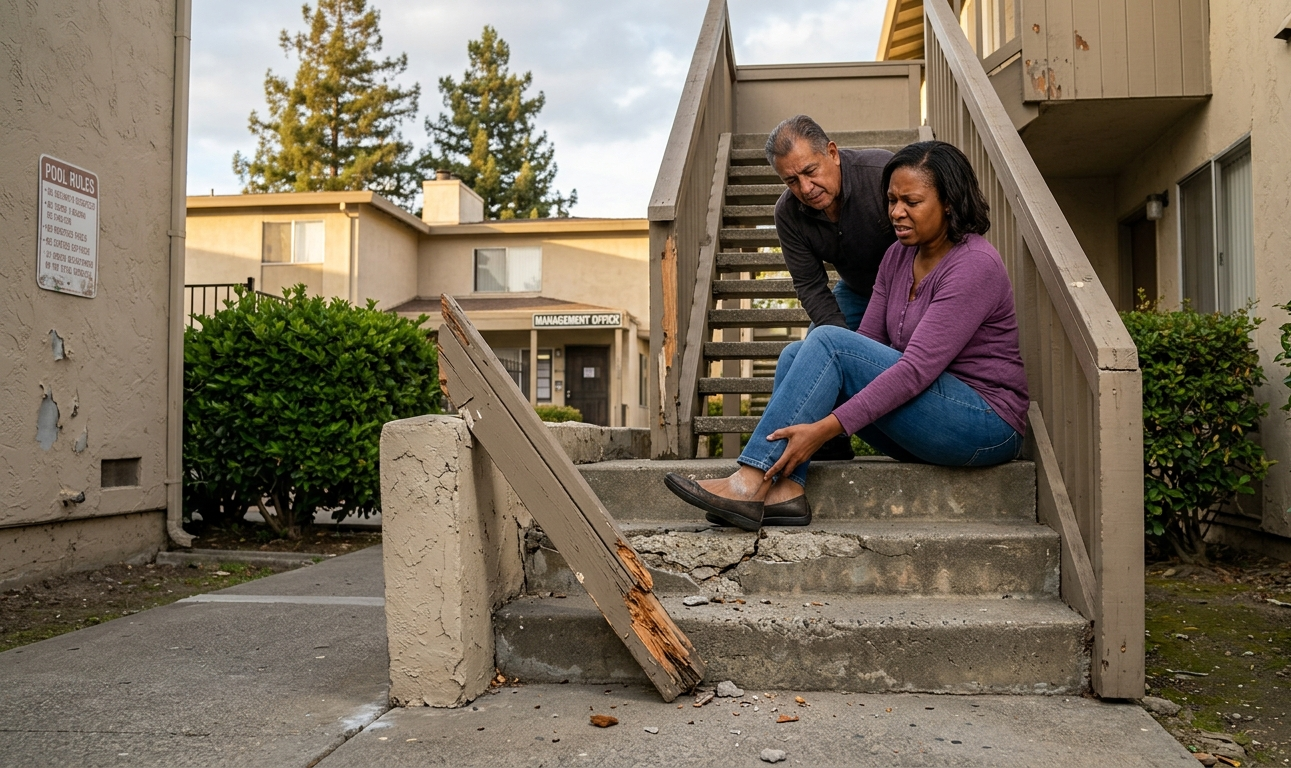
A tenant in a multi-unit Hayward apartment building reports a soft, sagging exterior staircase to the property manager three times over four months. The repair is never made. On a rainy night, the step gives way and the tenant suffers a fractured ankle and torn ligaments. Prior written complaints support a strong notice argument under both Civil Code §1714 and the warranty of habitability.
Hypothetical 2: Visitor Injured by a Falling Balcony Railing
A visitor leans against a second-floor balcony railing at a rental duplex near Mission Boulevard. The railing gives way and the visitor falls to the patio below, suffering serious back injuries. Inspection later shows widespread dry rot known to the landlord, supporting potential negligence under CACI 1003.
Hypothetical 3: Tenant Assaulted in a Dark Parking Lot
A tenant of a Hayward apartment complex is assaulted at night in an unlit parking garage. Records show repeated tenant complaints about broken lighting, prior break-ins, and a non-working security gate. A claim for negligent security may be analyzed under the Ann M. and Castaneda foreseeability framework.
Special Issues: Lease Waivers, Comparative Fault, and Multiple Defendants
Several recurring issues arise in rental property injury cases.
Lease Waivers Are Often Unenforceable
Some leases contain broad waivers attempting to shift all responsibility to the tenant. Under Civil Code §1953, a residential lease provision that purports to have a tenant waive certain protections (including the landlord’s duties under Civil Code §1941 and the right to recover for harm caused by the landlord’s negligence or unlawful act) is generally void as contrary to public policy. The exact effect depends on the specific provision and the circumstances of the injury, and a careful analysis is needed in every case.
Comparative Fault
California uses a comparative negligence system. A tenant or visitor whose own conduct contributed to the injury can still recover, but damages may be reduced by the percentage of fault assigned to that person.
Multiple Defendants
Premises liability claims often involve more than just the landlord. Property management companies, parent owners, maintenance contractors, and security vendors may share responsibility. Identifying the right defendants matters because each may carry separate insurance.
A careful East Bay personal injury attorney will analyze each of these issues as part of the early investigation, not at the end of the case.
What to Do After an Injury at a Hayward Rental Property
Several early steps can significantly strengthen a premises liability case.
- Get medical attention immediately, even if injuries feel manageable
- Photograph the unsafe condition from multiple angles before any repairs are made
- Take photos of your injuries in the days that follow
- Identify witnesses and obtain their contact information
- Gather written complaints, emails, texts, or maintenance requests that put the landlord on notice of the hazard
- Keep your medical bills, prescriptions, and out-of-pocket expenses
- Speak with a premises liability lawyer Hayward residents trust before giving any recorded statement to a landlord’s insurance carrier
How a Trial-Tested Premises Liability Attorney Can Help
Landlord and property management cases tend to involve large insurers and aggressive defense lawyers. A trial-tested attorney can level the playing field by:
- Promptly investigating the property and preserving evidence before repairs change the scene
- Obtaining prior complaints, inspection records, and police reports
- Retaining engineers, security experts, and medical professionals where needed
- Identifying every party responsible for the property
- Analyzing applicable laws, including Civil Code §§1941 and 1941.1, Health and Safety Code §17920.3, Civil Code §1714, and Civil Code §1953
- Preparing the case for trial when the insurance company refuses to offer fair compensation
At Mirador Law, our attorneys take premises liability cases throughout the East Bay seriously. We see real people behind every case and we believe the courtroom is not just about laws, it is about lives.
Conclusion
When a landlord fails to maintain a Hayward apartment, duplex, or rental home, tenants and visitors can pay the price with broken bones, brain injuries, or worse. California law gives injured people meaningful tools to hold property owners accountable, but those tools only work when the case is built carefully and on time. The strongest premises liability cases start with quick investigation, careful documentation of hazards, and an attorney who is not afraid to take the case to trial.
If you or a loved one was hurt because of an unsafe condition at a rental property anywhere in Hayward, the Tri-Valley, or the broader East Bay, the team at Mirador Law is ready to listen. Call our Pleasanton office at (925) 460-8484 or our Oakland office at (510) 785-8400 to talk through your case in a confidential consultation.
Frequently Asked Questions
Is my landlord responsible if I get hurt in my Hayward apartment?
A landlord may be responsible when an injury results from a dangerous condition the landlord knew about or should have known about and failed to fix within a reasonable time. Civil Code §1941, §1941.1, Health and Safety Code §17920.3, and Civil Code §1714 are commonly involved. Each case depends on its specific facts.
How long do I have to file a premises liability claim in California?
Most personal injury claims in California must be filed within two years of the date of injury under Code of Civil Procedure §335.1. Shorter deadlines may apply for claims against public housing authorities or other public entities under Government Code §911.2, which can require a written claim within six months.
What if I signed a lease that says I cannot sue my landlord?
Under Civil Code §1953, many provisions in residential leases that try to waive a tenant’s rights or the landlord’s duty of ordinary care are void as contrary to public policy. The exact effect depends on the provision and the circumstances. A premises liability lawyer can review the lease and help determine what protections still apply.
Can I bring a negligent security claim against my apartment complex?
Negligent security claims against apartment complexes typically follow the analysis from cases like Ann M. v. Pacific Plaza Shopping Center and Castaneda v. Olsher, which consider the foreseeability of the criminal conduct, the nature of the property, prior incidents, and the burden of additional security measures.
What if my injuries were caused by a contractor working on the property?
Property owners, management companies, and outside contractors may all share responsibility, depending on the facts. The Privette v. Superior Court doctrine limits a property owner’s liability for injuries to a contractor’s own employees in many situations, with several recognized exceptions. The analysis differs for non-employee plaintiffs, like tenants or visitors injured by contractor work. Identifying every responsible party early is one of the most important steps in maximizing recovery.
What kinds of compensation are available in a Hayward premises liability case?
Depending on the facts, recoverable damages can include medical bills, future medical care, lost wages, lost earning capacity, out-of-pocket expenses, pain and suffering, and in certain circumstances, punitive damages. A premises liability lawyer can evaluate the case and explain what is realistic given the specific injuries and evidence.
Disclaimer
This article is for general informational purposes only and is not legal advice. Reading this content does not create an attorney-client relationship with Mirador Law. Every case is different, and outcomes depend on the unique facts and applicable law. If you believe you have a legal claim, consult a licensed California attorney about your specific situation.
Attorney Advertisement. Mirador Law, Pleasanton, CA. Past results do not guarantee future outcomes. Every case is unique and results depend on individual facts and circumstances.