

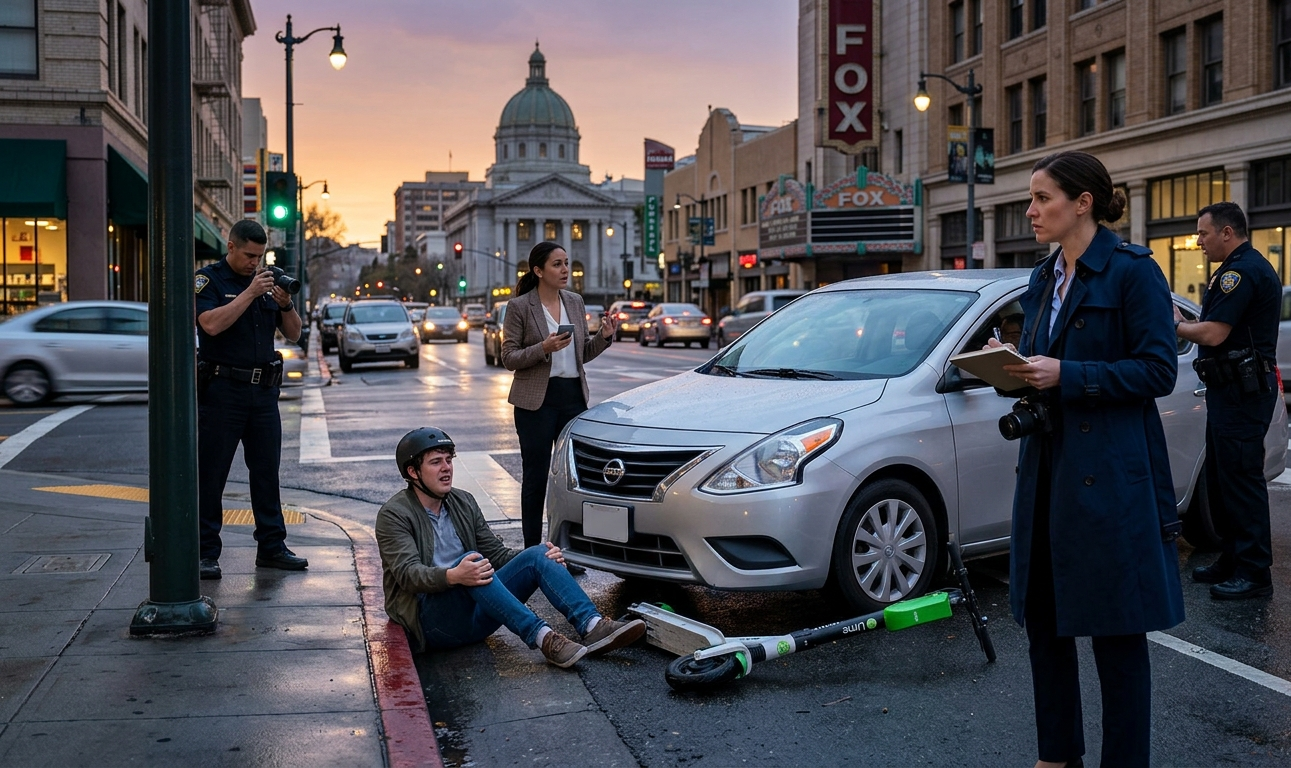
E-Scooter and E-Bike Accidents in Oakland: Who May Be Liable When a Lime, Bird, or Rider Causes a Crash?
Oakland’s downtown corridors, Jack London Square, Uptown’s entertainment district, and the dense commuter routes feeding into BART have all become busier with riders on shared e-scooters and e-bikes. Lime, Bird, and other companies turned micromobility into a daily reality, and many residents now mix scooter rides with walking, public transit, and driving. The convenience comes with a cost. Emergency rooms across the East Bay continue to see riders, pedestrians, and motorists hurt in collisions involving these devices, and the legal questions that follow are anything but simple.
If you were hurt in an Oakland crash involving an e-scooter or e-bike, whether you were the rider, a pedestrian, a driver, or a cyclist, the situation can feel overwhelming. Working with an experienced e-scooter accident lawyer Oakland residents trust is often the first step toward understanding who is responsible and what your options are.
This guide explains the liability questions that come up in these cases, the arbitration clauses buried in scooter user agreements, the insurance gaps many riders never see coming, recent corporate changes (including Bird’s bankruptcy and re-emergence as Third Lane Mobility), and a deadline that catches many injured people off guard: the six-month rule for claims against public entities.
Why E-Scooter and E-Bike Cases Are More Complicated Than They Look
A scooter crash on Broadway near 14th Street, or an e-bike collision on a bike lane along Telegraph Avenue, looks like a simple injury case until you start asking who is responsible. In reality, several parties may share fault, and each comes with its own insurance picture and legal hurdles.
Common potentially responsible parties include:
The rider of the scooter or e-bike
- A negligent driver who turned across a bike lane or opened a car door into traffic
- A pedestrian who stepped into traffic without looking
- The scooter or e-bike company, in certain limited circumstances
- A public entity responsible for dangerous roadway conditions, such as a pothole or unmarked construction zone
- A vehicle owner whose vehicle was being operated by the at-fault driver
Each of these defendants raises distinct legal questions. Combining them in one case requires careful planning by a personal injury attorney familiar with how these claims unfold in the San Francisco Bay Area.
Important Update: Bird Filed Bankruptcy and Now Operates as Third Lane Mobility
Anyone evaluating a claim involving “Bird” in 2026 should know that Bird Global filed for Chapter 11 bankruptcy in December 2023. The company exited bankruptcy through a Section 363 sale and a liquidating plan that became effective September 17, 2024. The Bird and Spin brands now operate under Third Lane Mobility Inc., the entity that acquired the operating assets through that process.
For injured people, this matters in several ways:
- Tort claims that existed before the bankruptcy (the “pre-petition” period) were channeled through the bankruptcy plan. Many of those claims face substantial obstacles to recovery beyond what was preserved in the plan documents.
- Tort claimants who challenged the bar order in court were not successful, and federal courts have held that further challenges are moot.
- Claims arising from incidents after September 17, 2024 generally are pursued against Third Lane Mobility and the operating subsidiaries that now manage the Bird fleet, not the former public company.
- Lime is not affected by the Bird bankruptcy. It continues to operate as a separate company and remains a possible defendant in cases involving its devices.
If your incident involves a Bird-branded device, an early step in evaluating the case is identifying the correct corporate defendant given when the crash happened. An experienced personal injury attorney can sort out who can actually be sued.
How California Vehicle and Bicycle Laws Apply to E-Mobility Devices
California law treats e-scooters and e-bikes differently from cars and from each other, and the rules continue to evolve.
Motorized Scooters
Under California Vehicle Code §407.5, a “motorized scooter” is defined to include the shared electric scooters distributed by companies like Lime and Bird. Several rules in the Vehicle Code apply, including:
- Riders must generally be 16 years of age or older
- Riders must wear a helmet if under 18
- Riders may not carry passengers on a single-rider device
- Motorized scooters generally must be operated in a Class II bike lane where available
- Riding on most sidewalks is prohibited
Electric Bicycles
California Vehicle Code §312.5 divides e-bikes into three classes: Class 1 (pedal-assist up to 20 mph), Class 2 (throttle-assist up to 20 mph), and Class 3 (pedal-assist up to 28 mph). The class affects where the bike can be ridden, helmet requirements, and age limits. Class 3 e-bikes follow stricter rules. California also enacted SB 1271 (2024), tightening battery and safety certification requirements for e-bikes in response to fires and recalls. Defective batteries or non-compliant devices can be relevant when a crash or fire causes injury.
When a rider violates one of these rules and a crash follows, fault analysis under California’s comparative negligence system can become complicated quickly. Comparative negligence does not bar recovery, but it can reduce damages by the percentage of fault assigned to the injured person.
Arbitration Clauses in Scooter and E-Bike User Agreements
Before unlocking a Lime or Bird scooter, riders click through a user agreement on their phone. Those agreements almost always include several provisions that affect later legal claims:
- A class action waiver
- A mandatory arbitration clause
- A choice-of-law and forum selection clause
- Indemnification language pointing fault back at the rider
Arbitration clauses can require disputes between the rider and the company to be resolved by private arbitration rather than in a public courtroom. There are arguments riders can sometimes make about enforceability, including unconscionability and arguments about scope, particularly when the dispute involves a non-signing third party.
For example, a pedestrian struck by a rider on a Lime scooter has typically not signed any agreement with Lime. Whether and how the company’s arbitration provisions reach a claim by that pedestrian raises distinct legal questions, often turning on doctrines like equitable estoppel.
These provisions do not necessarily prevent injured people from recovering. They do shape strategy from the very first day, which is why involving an East Bay personal injury attorney early matters.
Insurance Gaps That Catch Riders and Victims Off Guard
E-scooter and e-bike crashes often expose insurance gaps that no one anticipated.
Personal Auto Policies
Most personal auto policies do not provide liability coverage for injuries the policyholder causes while riding a scooter or e-bike. They sometimes do provide UM/UIM coverage when the insured is hit by a motor vehicle while riding, but coverage varies by policy.
Homeowners’ or Renters’ Insurance
Homeowners’ and renters’ policies sometimes provide liability coverage for off-premises bodily injury, but exclusions for “motorized vehicles” can be broadly written and may exclude e-scooter operation. Coverage is fact-specific.
Company Insurance
Scooter and e-bike companies typically maintain liability insurance, but pursuing the company depends on the legal theory, whether the rider misused the device, whether the equipment itself was defective or improperly maintained, and (for Bird-branded devices) the bankruptcy considerations described above.
Health Insurance and MedPay
For most injured people, the most immediate source of medical bill payment is their own health insurance or MedPay benefits under an auto policy. Both may seek reimbursement from any later settlement, which makes coordinating them a critical part of the case.
Dangerous Roadway Conditions and the Six-Month Government Claim Deadline
Some of the most serious e-scooter and e-bike crashes happen because of the roadway itself. Examples include:
- Deep potholes hidden by leaves or wet pavement
- Broken or missing manhole covers
- Long-term construction zones with poor signage or unsafe detours
- Bicycle lanes that disappear without warning
- Streetcar or transit rail grooves at dangerous angles
- Defective traffic signals at busy intersections
When a public entity (such as the City of Oakland, the County of Alameda, or Caltrans for state roads) is responsible for the dangerous condition, the claim is governed by California’s Government Claims Act and the dangerous-condition statute, Government Code §835. These cases come with deadlines that do not apply to ordinary injury cases.
The Six-Month Rule and the Government-Claims Roadmap
Government Code §911.2 generally requires a written claim for personal injury to be presented to the public entity within six months of the date of the injury. The required claim contents are spelled out in Government Code §910. If the claim is rejected (or deemed rejected by operation of law), Government Code §945.6 typically gives the injured person only six months from the date of the rejection notice to file a lawsuit. Missing any of these deadlines can permanently bar the claim.
The takeaway is simple: if a dangerous road condition may have contributed to your e-scooter or e-bike crash anywhere in Oakland, Berkeley, or elsewhere in Alameda County, the time to talk to a lawyer is now, not in a year.
Common Oakland E-Scooter and E-Bike Scenarios (Hypothetical)
The following hypothetical examples illustrate how these cases can unfold. They are not based on any specific client and are provided for educational purposes only.
Hypothetical 1: Rider Thrown by an Unmarked Pothole Near Lake Merritt
An Oakland resident rides a shared scooter along a bike lane near Lake Merritt and hits a deep, unmarked pothole, breaking a wrist and suffering a concussion. The case may involve a claim against the public entity responsible for the roadway under Government Code §835, subject to the six-month presentation deadline under §911.2 and the lawsuit deadline under §945.6.
Hypothetical 2: Pedestrian Struck on a Sidewalk
A pedestrian walking near Jack London Square is struck by a scooter rider on the sidewalk and suffers a fractured ankle. The pedestrian may have claims against the rider and, depending on the facts, may also explore whether other parties bear responsibility. Because the pedestrian did not sign the scooter company’s user agreement, arbitration analysis differs.
Hypothetical 3: E-Bike Rider Hit by a Turning Vehicle
A delivery worker on a Class 2 e-bike is hit by a driver making a right turn across the bike lane on Telegraph Avenue. The rider suffers a torn rotator cuff and a head injury. Comparative fault, the driver’s auto liability coverage, the rider’s UM/UIM coverage, and potentially workers’ compensation may all come into play.
What to Do After an E-Scooter or E-Bike Crash in Oakland
A few early steps can significantly strengthen a later case.
- Call 911 and get medical attention, even if injuries feel minor
- Take photos and videos of the scene, the device, the roadway, and your injuries
- Identify witnesses and get their contact information
- Screenshot trip and ride data in the scooter or e-bike app before it disappears
- Preserve the device if possible, especially if equipment failure is suspected
- Avoid recorded statements with insurance adjusters until you have spoken with a lawyer
- Talk to an e-scooter accident lawyer as soon as practical, especially if a dangerous road condition may be involved
How a Trial-Tested Oakland Attorney Can Help
E-scooter and e-bike cases involve product issues, insurance complexity, arbitration battles, government claims that move on tight timelines, and post-bankruptcy complications when Bird-branded devices are involved. A trial-tested attorney can:
- Investigate the crash before evidence disappears, including roadway conditions and device records
- File timely government claims to preserve all options under §911.2 and §945.6
- Identify the correct corporate defendant in Bird-related cases given the Third Lane Mobility transition
- Push back on overreaching arbitration provisions where appropriate
- Identify every applicable insurance policy
- Coordinate medical care so treatment gaps do not become defense arguments
- Prepare the case for trial when the company or its insurer refuses to negotiate fairly
At Mirador Law, our trial-tested approach has produced significant results for injured people across Northern California. See our Oakland personal injury page for more on how we work with East Bay clients.
Conclusion
E-scooter and e-bike crashes in Oakland often involve more moving parts than people expect: multiple potentially responsible parties, scattered insurance coverage, arbitration clauses tucked into user agreements, short deadlines when a public entity is involved, and, for Bird-branded devices, the additional layer of corporate restructuring under Third Lane Mobility. The strongest cases start with quick investigation, careful preservation of evidence, and a clear understanding of how California law applies to these growing forms of urban transportation.
If you or a loved one was hurt in an e-scooter or e-bike crash in Oakland, Berkeley, or elsewhere in the East Bay, the team at Mirador Law is ready to listen. Call our Oakland office at (510) 785-8400 or our Pleasanton office at (925) 460-8484 to talk through your case in a confidential consultation.
Frequently Asked Questions
Can I still sue Bird after the bankruptcy?
Bird Global filed Chapter 11 in December 2023, and its operating assets are now held by Third Lane Mobility Inc., which became effective September 17, 2024. Whether you can pursue Bird-related claims depends heavily on when the incident occurred and how the bankruptcy plan treats your category of claim. Speak with an attorney quickly so the correct defendant can be identified before deadlines run.
Can I sue Lime if I am hurt riding one of their scooters?
Whether a claim can be brought against the company depends on the facts of the crash, including whether the device was defective, whether maintenance was negligent, and how the user agreement applies. Arbitration provisions in the user agreement may also shape how and where the claim is resolved.
What is the deadline for filing a claim against the City of Oakland for a dangerous road condition?
Under Government Code §911.2, claims against public entities for personal injury generally must be presented in writing within six months of the date of the injury. Under §945.6, the lawsuit deadline after a rejection notice is typically six months from that notice.
Does my car insurance cover injuries I cause while riding an e-scooter?
Most personal auto policies in California do not provide liability coverage for injuries caused while riding an e-scooter. UM/UIM coverage may apply if you are hit by a motor vehicle, but coverage depends on the policy.
What if I was hit by an e-scooter rider as a pedestrian in Oakland?
Pedestrians struck by scooter or e-bike riders typically have claims against the rider, and depending on the facts, may have additional claims against other parties. Because pedestrians have not signed the scooter company’s user agreement, the arbitration analysis may differ from claims brought by riders.
Are helmets required for e-bike and e-scooter riders in California?
California requires helmets for motorized scooter riders under 18 and for all riders of Class 3 e-bikes. Helmet rules can interact with comparative fault analysis after a crash, although failure to wear a helmet does not automatically bar recovery.
How long does an e-scooter or e-bike injury claim take to resolve?
The timeline depends on the complexity of the case, the seriousness of the injuries, the number of defendants, and whether the case settles or goes to trial. Cases involving public entities, multiple insurers, or arbitration provisions often take longer than straightforward auto claims.
Disclaimer
This article is for general informational purposes only and is not legal advice. Reading this content does not create an attorney-client relationship with Mirador Law. Every case is different, and outcomes depend on the unique facts and applicable law. If you believe you have a legal claim, consult a licensed California attorney about your specific situation.
Attorney Advertisement. Mirador Law, Pleasanton, CA. Past results do not guarantee future outcomes. Every case is unique and results depend on individual facts and circumstances.